
☰
Most efficient solar panels 2025.
Solar panel efficiency refers to the percentage of sunlight that a solar panel converts into usable electricity.
Over the past decade, advancements in photovoltaic technology have increased average conversion efficiency from 15% to over 23%. This improvement has led to a rise in standard residential solar panel power ratings, from 250W to more than 450W.
Efficiency is primarily influenced by two factors: photovoltaic (PV) cell efficiency, which depends on the solar cell design and silicon type, and overall panel efficiency, which is affected by cell layout, configuration, and panel size. Increasing panel size enhances efficiency by capturing more sunlight, with the most advanced panels now exceeding 700W in power output.
Maxeon, formerly SunPower, remains the leader in residential solar panel efficiency, holding the top spot with its limited production 7 Series panels. However, Aiko Solar has taken the spotlight with its larger commercial-sized panels, achieving an impressive efficiency of 24.2%. Historically, Maxeon has led the industry for well over a decade, but Aiko's innovation with the Neostar Series, launched in 2023, has pushed boundaries. The Neostar panels feature cutting-edge All-Back-Contact (ABC) cell technology, initially offering a module efficiency of 23.6%. The 3rd-generation Neostar panels, due to be released in 2025, will surpass 24.2%, setting a new benchmark for solar panel performance.
Recom Tech’s next-generation Black Tiger series, with 23.6% efficiency, uses a new TOPcon Back-contact cell architecture. LONGi Solar was previously the second manufacturer, behind Sunpower, to reach a module efficiency level of 23% with the new Hi-Mo 6 Scientists series, based on a hybrid IBC cell design, which LONGi calls HPBC. Canadian Solar and, more recently, REC and Huasun Solar revealed next-generation panels built using HJT cells, which are on par with the efficiency level of the renowned Maxeon series.
Other leading manufacturers include Jinko Solar, SPIC, TW Solar, Trina Solar, and JA Solar, which feature next-generation TOPCon and HJT cells. Higher-efficiency panels featuring N-type TOPCon cells from TW Solar, Astronergy, DAS Solar, Risen, Qcells and most established manufacturers have helped boost panel efficiency above 22% across the industry.
| # | Make | Model | Power | Efficiency |
|---|---|---|---|---|
| 1 | Maxeon | Maxeon 7 | 445 W | 24.1% |
| 2 | Aiko Solar | Neostar 2P | 475 W | 23.8% |
| 3 | Recom Tech | Black Tiger Series | 460 W | 23.6% |
| 4 | SPIC | Andromeda 3.0 | 460 W | 23.6% |
| 5 | Longi Solar | Hi-Mo 6 Scientist | 455 W | 23.3% |
| 6 | Huasun Solar | Himalaya G12 | 450 W | 23.0% |
| 7 | Canadian Solar | TOPHIKu6 | 470 W | 23.0% |
| 8 | Jinko Solar | Tiger NEO | 460 W | 23.0% |
| 9 | Winatoo | WST-NGX-D3 | 450 W | 23.0% |
| 10 | Trina Solar | Vertex S+ | 455 W | 22.8% |
* Last update: December 2024. Residential size panels - 54 to 66 cells (108-HC, 120-HC or 132-HC) and 96/104 cell formats. Does not include commercial panels greater than 2.0m in length.
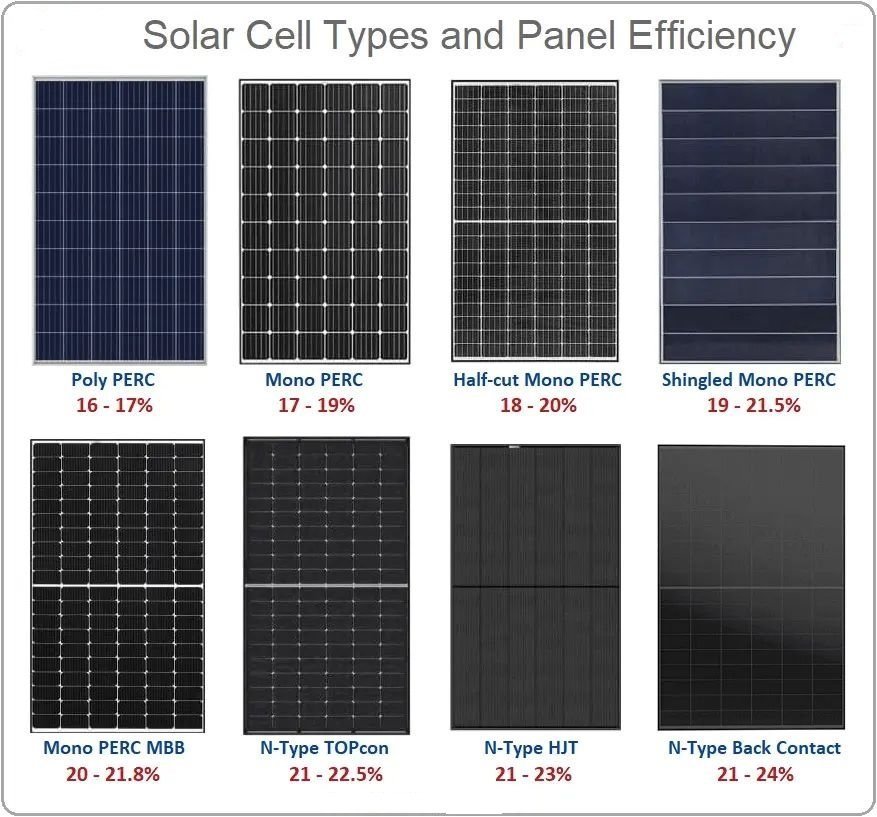
Cell efficiency is determined by the cell structure and type of substrate used, which is generally either P-type or N-type silicon, with N-type cells being the most efficient. Cell efficiency is calculated by what is known as the fill factor (FF), which is the maximum conversion efficiency of a PV cell at the optimum operating voltage and current.
Note cell efficiency should not be confused with panel efficiency. The panel efficiency is always lower due to the internal cell gaps and frame structure being included in the calculated area.
The cell design plays a significant role in panel efficiency. Key features include the type of base silicon substrate, busbar configuration, and passivation type. Panels built using back-contact (IBC) cells are currently the most efficient (up to 24.1%) due to the high purity N-type silicon substrate and no losses from busbar shading. However, panels developed using the latest N-Type TOPcon and advanced heterojunction (HJT) cells have achieved efficiencies above 23%.
| Manufacturer | Model | Efficiency (%) | Power Output (W) |
|---|---|---|---|
| Maxeon | SunPower 7 Series | 24.1% | 430W |
| Aiko Solar | Neostar Series | 24.2% | 460W |
| Recom Tech | Black Tiger Series | 23.6% | 450W |
| LONGi Solar | Hi-Mo Series | 23.0% | 440W |
Cell temperatures above or below STC (25°C) affect power output. The temperature coefficient (%/°C) indicates how much power decreases with each degree increase (lower values are better).
* Cell temperature typically 20-30°C above ambient air temperature
* Lower values indicate better high-temperature performance